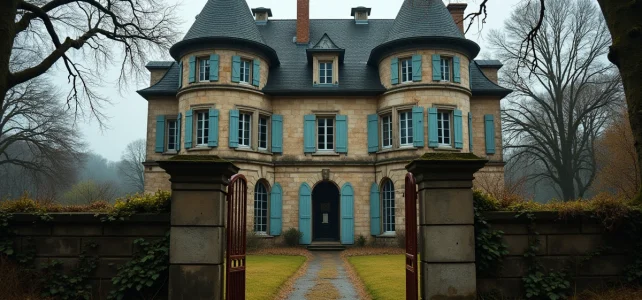
Acquiring an abandoned castle for a symbolic sum in France relies on a precise mechanism: a municipality or a private owner transfers a property that has become unmanageable, in exchange for a commitment to renovation. The operation seems attractive on paper, but the actual costs, legal constraints, and heritage obligations often turn the dream into a financial pit.
This article compares the expense items and risks to measure the gap between the displayed acquisition price and the total cost of such a project.
Acquisition Cost vs. Actual Cost: The Gaps to Anticipate
The purchase price of an abandoned castle, sometimes reduced to a symbolic euro, represents only a marginal fraction of the overall budget. The real financial burden focuses on the restoration, regulatory obligations, and long-term maintenance.
| Expense Item | Classic Acquisition (habitable castle) | Abandoned Castle Transferred at Symbolic Price |
|---|---|---|
| Purchase Price | Variable depending on area and region | Symbolic or none |
| Technical Diagnostics | Standards (DPE, asbestos, lead) | Comprehensive structural audit required |
| Major Works | Limited or nonexistent | Roofing, framework, load-bearing walls, foundations |
| Compliance Upgrades | Partial | Total (electricity, sanitation, accessibility) |
| Heritage Constraints | Variable | Often strengthened (classification, surroundings) |
| Time Before Occupancy | Short | Several years of construction |
The gap lies in the major works and compliance upgrades. A castle uninhabited for decades accumulates structural issues (infiltrations, sagging floors, damaged framework) that only a thorough heritage audit can quantify before signing.
Finding an abandoned castle to give away in France requires checking in advance that the renovation budget remains compatible with the buyer’s financial capacity, lest they find themselves the owner of a ruin with no means to act.

Ownership and Co-ownership: The Legal Trap of Abandoned Castles
An abandoned castle almost always poses a problem of title ownership. The most common situation is co-ownership due to inheritance: multiple heirs hold the property without all being identified. Some reside abroad, others are unaware of their heir status, and still others refuse any transfer.
The inheritance search, conducted by a specialized notary, can take several months. As long as not all co-owners have given their consent or a court has not ruled, the sale remains blocked. An eager buyer risks signing a compromise on a property whose ownership is disputable.
Easements and Rights of Way
Beyond co-ownership, easements represent another blind spot. A rural castle may be burdened with agricultural rights of way, view easements, or pipelines crossing the land. These easements do not disappear with the change of ownership. They must be included in the mortgage status requested from the land publicity service.
- Request a complete and recent mortgage status, not just a copy of the seller’s title deed
- Check with the town hall for the existence of public utility easements (networks, municipal paths)
- Ask the notary for a comprehensive inheritance search before signing any compromise
Surrounding Areas and Recent Heritage Constraints
Even a castle that is not classified as a historical monument may be subject to heavy constraints if it is located within the defined perimeter of the surroundings (PDA) of a neighboring monument. The recent reform of the PDAs has changed the game for buyers of old properties.
The mandatory consultation of the owner during the public inquiry prior to the creation of a PDA has now been removed. In practical terms, a protection perimeter can be extended or created around a historical monument without the owner of the concerned castle being directly involved in the discussion beforehand.
The PDAs can also include coherent built ensembles around a monument, which extends the constraints on works (facades, openings, extensions) to buildings that are not themselves classified. A “regular” castle located in these surroundings finds itself subject to the opinion of the Architect of the Buildings of France for any external modification.
Consequences on a Renovation Project
These constraints are not limited to aesthetics. They may impose specific materials (slate instead of tiles, lime plaster, wooden joinery), prolong the processing times for building permits, and significantly increase the cost of works.
Before making any purchase offer, consulting the local urban planning plan and the territorial architecture and heritage service allows for assessing the actual extent of obligations. A castle in a surrounding perimeter costs more to renovate than an identical property outside the perimeter.

Renovation Commitment: Contractual Clause and Acquisitive Prescription
When a municipality transfers an abandoned castle at a symbolic price, it attaches a renovation commitment clause to the sale. The buyer commits to carrying out works within a defined timeframe, under penalty of resolution of the sale. This mechanism protects the community against speculative buyers who would resell the bare land after demolition.
Acquisitive prescription (usucapion) constitutes another approach for certain truly abandoned properties. Under French law, continuous, peaceful, and public possession for thirty years may allow one to claim ownership of a property. This path remains rare for castles, as it requires effective and uncontested occupation over a very long period.
- Verify the duration and exact content of the renovation clause before signing
- Ensure that the imposed timeframe is realistic given the condition of the property and the heritage constraints
- Do not confuse occasional occupation with continuous possession in the legal sense
- Consult a lawyer specialized in real estate law before any steps based on acquisitive prescription
The actual cost of a castle transferred for a symbolic euro is measured in years of work, regulatory constraints, and compliance costs. The gap between the acquisition price and the total restoration budget remains the determining parameter. A structural audit, a complete inheritance search, and a verification of the heritage protection perimeters are the three minimum checks before any signing.