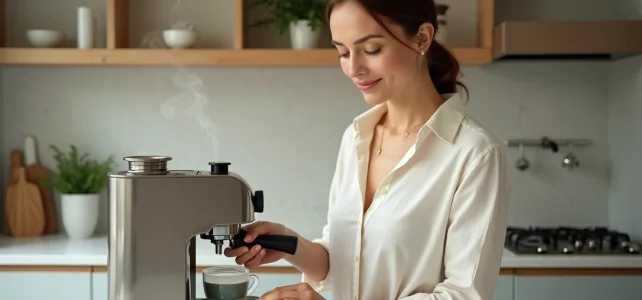
You open the cupboard, grab a capsule at random, and press a button. The coffee flows, lukewarm, with no particular aroma. This automatic morning scenario drives many households to change their machine, but the market offers so many formats that one often ends up buying in the wrong place or for the wrong use.
Water hardness and maintenance: the criterion that no one looks at in stores
Before even comparing brands or types of machines, one should start by turning on the tap. The quality of the water directly affects the taste in the cup and the lifespan of the device. Very hard water clogs the internal pipes, accelerates limescale buildup, and requires descaling much more often.
Several recent user guides recommend using filtered water or spring water for a clearer result. If your tap water is hard, check that the machine includes a water filter or that it is compatible with a filtering pitcher. This detail, rarely highlighted in comparisons, significantly impacts long-term maintenance costs.
Beyond limescale, the risks of biofilm and mold in the internal circuits are increasingly documented. A machine with an easily removable extraction group, featuring automatic rinsing programs, will be much simpler to keep clean. Detailed sheets on the ease of maintenance of different models can be found on espresshome.com, which helps in comparing before purchase.
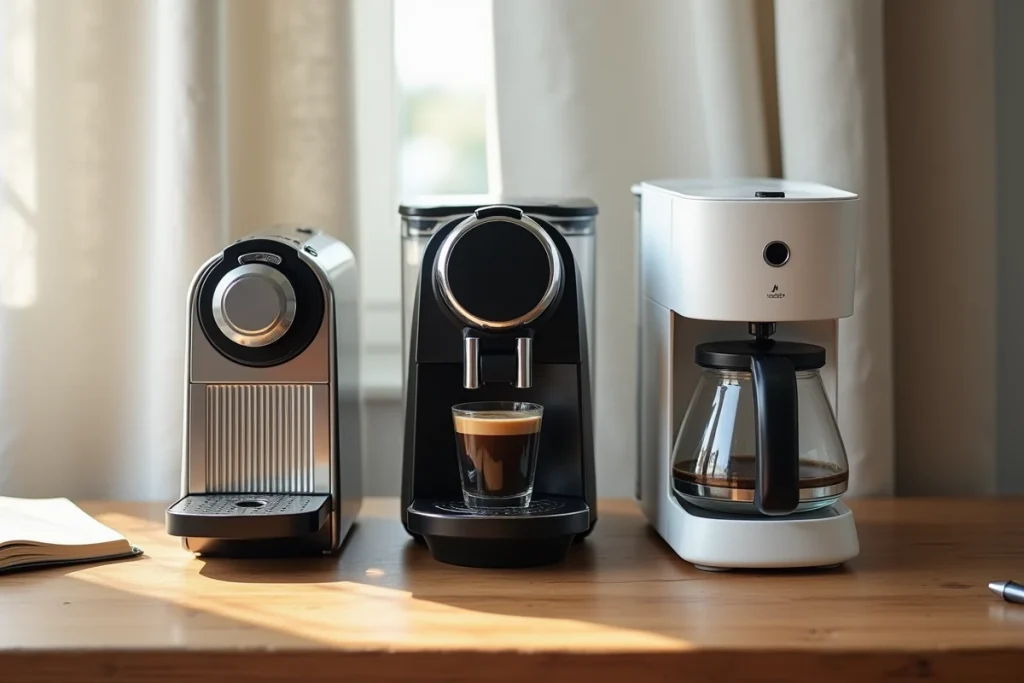
Bean, capsule, or filter machine: choose according to your actual consumption
The classic reflex is to list the available technologies. Instead, let’s start from a concrete case: how many cups per day, for how many people, and what type of coffee.
One to two coffees per day for one person
A capsule or pod machine does the job. Quick preparation, minimal footprint, no adjustments. The cost per cup remains the highest of all formats, but for a low volume, the annual difference is modest.
Three cups or more, or a household of multiple drinkers
This is where a bean-to-cup coffee machine with an integrated grinder makes perfect sense. Freshly ground beans release aromas that a capsule cannot replicate, and the cost per cup decreases significantly as the volume increases. Current models from brands like Jura, DeLonghi, or Philips allow you to adjust the grind size, temperature, and water volume.
Long filter coffee enthusiasts
For those who prefer a generous mug rather than a strong espresso, the filter coffee maker remains the most economical and simplest solution. Some bean machines also offer a long coffee mode, but the result in the cup differs from a true gravity filter. Feedback on this point varies depending on the models.
Grind settings and temperature: what separates a good espresso from a bland coffee
On a bean machine, the ability to adjust the grind is the parameter that most influences extraction. A grind that is too coarse produces a watery coffee. Too fine, and the water passes through slowly, resulting in bitterness.
Most consumer machines offer between five and twelve grind levels. For a short, dense espresso, you go down to the fine settings. For a longer coffee, you go up. This is not a gimmick: adjusting the grind radically transforms the taste without changing the beans.
The water temperature plays a comparable role. If it’s too low, extraction is incomplete, and the coffee lacks body. If it’s too high, bitter compounds are extracted. Machines that allow temperature adjustments (even on three levels) provide a significant margin for maneuver, especially when changing roasts.

Coffee machine budget: think in annual cost rather than purchase price
The purchase price tells only part of the story. Here are the items to include for an honest comparison:
- The cost of consumables (capsules, beans, pods, filters) related to the number of daily cups. Coffee beans remain the cheapest format per cup, while capsules are the most expensive.
- The frequency and cost of descaling: tablets, liquid solutions, replacement of built-in water filters. Hard water multiplies these expenses.
- The estimated lifespan: a well-maintained bean machine generally lasts longer than an entry-level capsule machine, amortizing the higher initial investment.
Thinking over one or two years of use helps avoid the trap of a low-cost machine that becomes expensive due to proprietary capsules.
Milk drinks at home: steam wand or automatic system
For cappuccino or latte lovers, the milk frothing system makes a real difference in daily use. There are two main options on home machines.
- The manual steam wand provides the most control over the texture of the foam. It requires a bit of practice but allows for dense microfoam, similar to what you find in coffee shops.
- The automatic system (integrated carafe or immersion tube) simplifies preparation. You press a button, and the machine doses and heats the milk. The result is consistent, but the foam is often less fine than with a manual wand.
- Cleaning is the weak point of milk systems: the circuits must be rinsed after each use to avoid residue. A removable system makes this step easier.
If you only use milk on weekends, an external frother may suffice and avoid complicating the main machine.
The choice of a home coffee machine comes down to three trade-offs: the volume of consumption that guides the format, the hardness of the water that conditions maintenance, and the level of customization desired for grind and temperature. Starting from these three concrete constraints quickly filters the options and avoids regrettable purchases after six months.