
An appliance that breaks down or seems outdated does not automatically become waste. The second life of household appliances relies on a series of technical decisions: diagnosing the fault, assessing the repair cost, choosing between reuse and recycling. Each step directs the appliance towards a different pathway, with direct consequences for the environment and the wallet.
Fault Diagnosis: The First Step Before Any Decision
Before giving away, reselling, or recycling equipment, it is essential to know what is no longer functioning. A washing machine that does not drain often suffers from a clogged filter or a worn pump. An oven that no longer heats may have a burnt-out heating element, which can be replaced for a few dozen euros.
The majority of faults in large household appliances involve wear parts: seals, belts, thermostats, capacitors. In small appliances (kettles, food processors, cordless vacuum cleaners), the battery is the main weak point.
In this regard, the European regulation 2023/1542 on batteries mandates that starting from February 18, 2027, batteries integrated into many devices must be removable and replaceable by consumers. This requirement will facilitate the repair of cordless small appliances, which today often end up in the trash due to the inability to change the battery.
Specialized platforms for refurbished appliances, such as refair.fr, allow users to find restored and verified devices, providing a concrete alternative to replacing them with new ones.
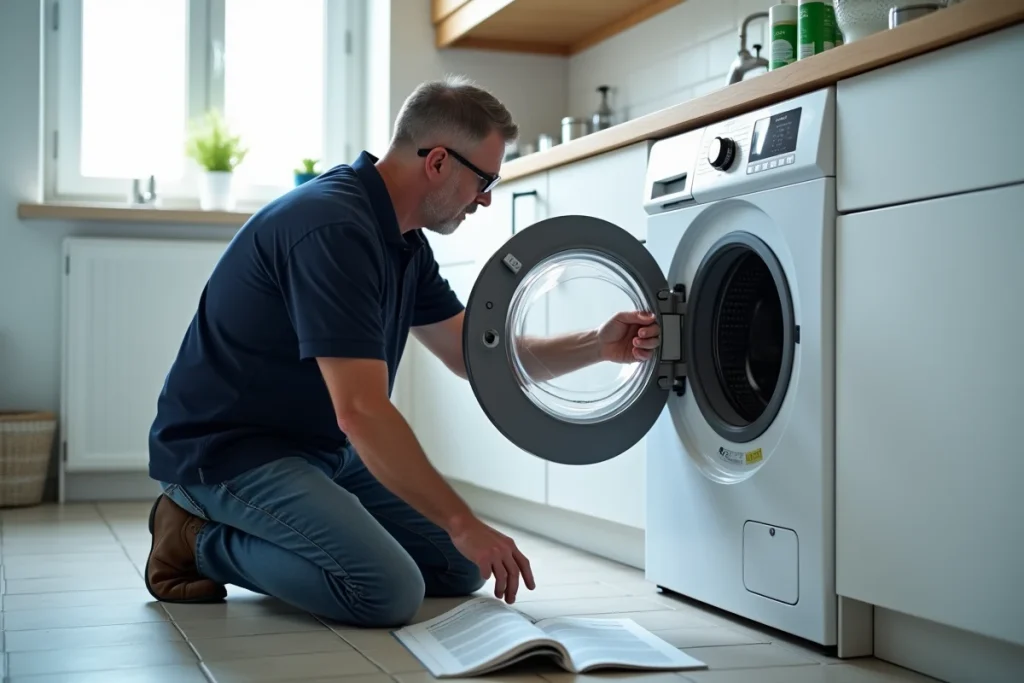
Appliance Repair and Repair Bonus: What is Covered
The repair bonus finances part of the intervention of a certified repair technician. This scheme, supported by accredited eco-organizations, covers a specific list of devices: washing machines, dishwashers, tumble dryers, refrigerators, vacuum cleaners, coffee machines, among others.
To benefit from it, two conditions must be met: calling on a repair technician referenced by an eco-organization (such as ecosystem), and the repair must address an actual fault, not routine maintenance. The amount of the bonus is deducted directly from the bill.
When Repair is No Longer Worth the Cost
The common-sense rule is to compare the repair estimate to the price of a refurbished or equivalent new appliance. If the repair exceeds half the price of a new one for an already old appliance, reuse or donation becomes more relevant.
Another signal: repeated faults. An appliance repaired twice in a year for different issues shows signs of widespread wear. It is better to direct it towards donation or recycling rather than invest again.
Donation and Reuse of Household Appliances: Solidarity Channels
Donating working (or repairable) appliances supports structures in the social and solidarity economy. Networks like Envie, Emmaüs, Secours Populaire, and other associations collect, repair, and resell these devices at reduced prices.
A working appliance donated has more value than a broken one. Associations have restoration workshops, but their repair capacities remain limited. A functioning refrigerator will be redistributed within a few days. A broken refrigerator will require a technician for several hours, with no guarantee of success.
For the donation to be useful, a few concrete criteria:
- The appliance must be complete (power cable, basic accessories) and clean, cleaned before deposit
- Appliances over fifteen years old, even functional, are rarely accepted due to their high energy consumption and lack of spare parts
- Small cordless appliances with a dead battery generally do not interest associations, unless the battery is replaceable

Recycling and Collection of Electrical Waste: Obligations and Channels
When an appliance cannot be repaired or donated, it falls into the category of waste electrical and electronic equipment (WEEE). Their treatment is regulated by the environmental code, which prohibits throwing them away with household waste.
There are three main options for collection:
- The municipal waste disposal site, which has bins dedicated to WEEE, separated between large and small appliances
- Return at the store when purchasing an equivalent appliance (the “one-for-one” obligation imposed on distributors)
- Collection points managed by accredited eco-organizations, often located in supermarkets or recycling centers
Since January 1, 2026, waste storage and treatment facilities must apply enhanced procedures to identify waste containing lithium batteries. Cordless vacuum cleaners, household robots, portable tools: these devices require specific sorting due to the fire risk associated with damaged lithium cells.
What Happens to Recovered Materials
Recycling allows for the extraction of ferrous metals, copper, aluminum, plastic, and electronic components. Metals are melted down and reintroduced into production chains. Plastics, depending on their nature, are ground and reused or energy-recovered.
The recovery rate depends on the type of appliance. Large appliances (mainly metallic) are recycled more efficiently than small appliances, which contain more mixed plastics and complex electronic components.
Extending the lifespan of an appliance by a few years remains, in most cases, more beneficial for the environment than the most efficient recycling. Recycling recovers materials but does not compensate for the energy and resources mobilized to manufacture a new appliance. The hierarchy remains the same: repair first, donate next, recycle as a last resort.