
A teacher who prepares their lessons in the evening, manages very different student profiles in the morning, and fills out administrative forms between two teaching sessions: this daily routine has become the norm in today’s education. The challenges faced by teachers go beyond the transmission of knowledge. They touch on mental health, work organization, and even the educational system’s ability to retain its professionals.
Bureaucratic overload and non-communicative digital tools
Have you ever noticed how many platforms a teacher has to use in a single day? Between the grading software, the digital lesson planner, the absence reporting platform, and institutional reporting tools, the multiplication of interfaces creates a specific form of fatigue.
In Italy, this phenomenon has been described as structural: teachers complain about redundant and non-interoperable reporting platforms. Data entered into one tool often has to be re-entered into another. The time spent in front of these interfaces does not produce educational value.
The problem is not digital tools per se. It is the lack of coordination among the tools imposed on educational institutions. A teacher who spends several hours a week on repetitive administrative tasks loses time on lesson preparation, individual student follow-up, or simply resting. To learn more about Mon Blog Beauté, this topic is also discussed from a complementary angle.
The administrative burden is rarely visible from the outside. Families see a teacher in front of their class. They do not see the two hours of data entry that follow.
Psychosocial risks in teaching: what OSHA documents
The European Agency for Safety and Health at Work (OSHA) associates teaching with a precise combination of risk factors: high workload, strong emotional demands, limited autonomy, job insecurity, and exposure to violence. This combination is not anecdotal. It produces measurable effects on the well-being and retention of teaching staff.
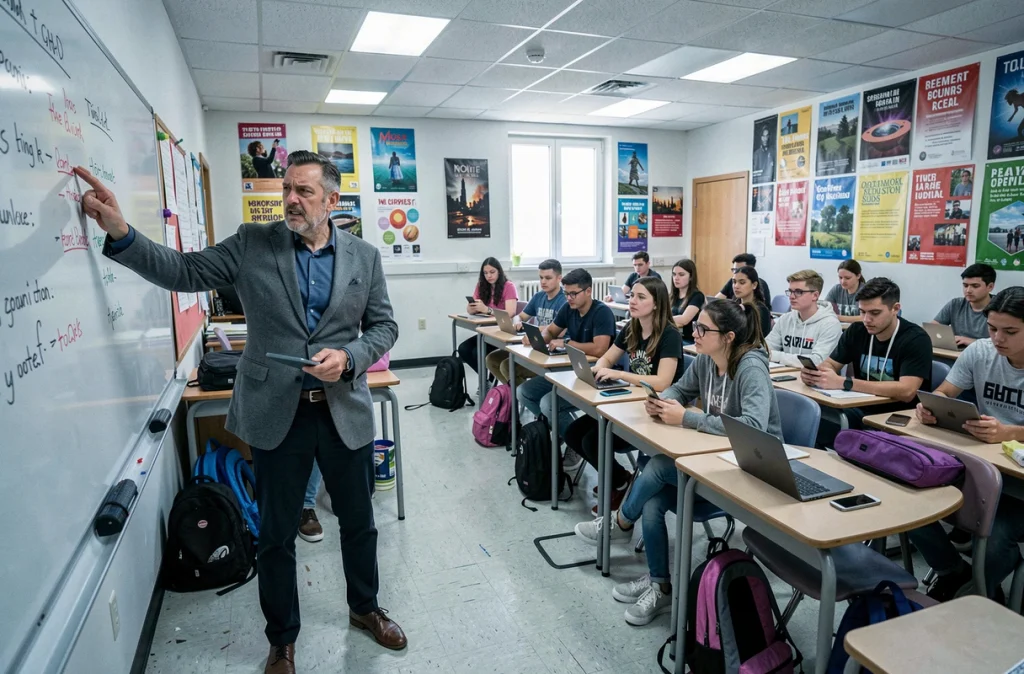
Let’s take a concrete example. A middle school teacher typically manages heterogeneous classes, with students presenting learning disabilities (dyslexia, ADHD), varying levels, and sometimes difficult family situations. The emotional demand of each lesson is comparable to that of caregiving professions.
Limited autonomy and loss of meaning
Pedagogical autonomy is often reduced by tightly structured programs, standardized assessments, and contradictory injunctions. A teacher may simultaneously receive instructions to differentiate their teaching and to adhere to the same progression schedule for all.
This tension between contradictory injunctions generates a sense of helplessness. When a qualified professional cannot adapt their practice to what they observe, motivation erodes.
Global teacher shortage: a problem of departures, not just recruitment
UNESCO has documented a projected need for 44 million additional teachers by 2030 to achieve universal education. This figure does not only concern the creation of new positions. It includes replacing teachers who leave the profession.
This is a point often overlooked in discussions about recruitment. Training new teachers is not enough if working conditions push current teachers out. The barriers to retention are concrete:
- Workloads that leave little time for ongoing training, as needs evolve each year
- A cost of professional training often borne by the teacher themselves, in both time and money
- A salary and symbolic recognition that do not reflect the increasing complexity of the profession
The shortage of qualified teachers affects all educational levels, from primary to higher education. It is more pronounced in certain subjects (mathematics, sciences, languages) and in less attractive geographical areas.

Ongoing training for teachers: very concrete obstacles
Ongoing training throughout one’s career seems logical in a profession where knowledge, audiences, and tools are constantly changing. In practice, the lack of time is the primary obstacle to ongoing training.
A full-time teacher who teaches their classes, prepares lessons, grades assignments, and manages administrative follow-up often has no time left to attend training. When training opportunities exist, they sometimes occur during school holidays, creating a direct conflict with the need for rest.
Training sometimes disconnected from the field
The other barrier is qualitative. Teachers regularly describe top-down, theoretical training that is far removed from their daily issues. Training on pedagogical differentiation that does not take into account the reality of a class of 30 students with three students with specific needs remains abstract.
The formats that work best combine several characteristics:
- A grounding in real classroom situations, not in theoretical cases
- A time for peer exchange, allowing for comparison of practices
- Follow-up after training, to support concrete implementation
- Consideration of training time in the overall workload
Without these conditions, ongoing training remains a stated goal but rarely achieved.
Heterogeneity of students and differentiation burden
The diversity of student profiles in a single class has significantly increased. Identified learning disabilities, non-native speakers, significant level gaps, and disability situations: each configuration requires specific adaptation.
Pedagogical differentiation is not a simple adjustment. It involves preparing multiple versions of the same activity, anticipating the specific difficulties of each profile, and simultaneously managing very different learning paces. A teacher who truly differentiates multiplies their preparation time.
This requirement directly conflicts with time constraints and class sizes. Differentiating for five different profiles in a class of 15 students is feasible. Doing so in a class of 30 is a constant balancing act.
The challenges of current education are not isolated problems. Administrative overload amplifies fatigue, which reduces the ability to differentiate, which deteriorates the sense of competence, which accelerates departures. It is this chain reaction that makes the situation difficult to resolve with one-off measures.