
The travel document for refugees (TVR) issued by France opens a specific travel perimeter, but its territorial and legal limits remain poorly understood. The confusion between the right to move and the right of entry causes boarding refusals or border blockages each year for holders who are otherwise compliant on the French side.
Territorial limits stated on the TVR and restrictions from countries of origin
The document itself explicitly mentions the excluded countries. The state or states for which persecution has been recognized as valid are crossed out from the validity perimeter. A return to the country of origin, even for family reasons, does not fall under a simple tourist trip.
The direct consequence is the endangerment of status. A trip to the country of origin can trigger a procedure for cessation of protection, based on the CESEDA. Any return to the country of origin risks losing refugee status. In cases of imperative necessity (death of a close relative, for example), a prefectural pass can be requested, but the process remains exceptional and subject to discretionary assessment.
We recommend systematically checking the mentions on the TVR before any booking, including for flight layovers transiting through an excluded country.
Schengen Area and short stays with a French travel document
A valid French TVR allows for short-term travel in other Schengen Area states. This possibility is often presented as a major advantage of the Geneva Convention travel document, and it is, provided one understands its boundaries.
In practice, the holder can move within the Schengen zone under the same rules as a third-country national holding a valid French residence permit. The authorized duration is that of a short stay. The TVR does not confer any right of residence in another member state. The beneficiary remains protected by France and linked to its asylum system.
For those considering traveling with a refugee travel document outside the Schengen Area, the situation changes radically depending on the destination.

Visa required outside Schengen: the issuing country takes precedence over former nationality
This is the most misunderstood technical point. Outside the Schengen Area, the visa requirement depends on the country that issued the travel document, not on the holder’s former nationality. A Syrian refugee holding a French TVR will not be treated as a Syrian national by the destination country, but as a holder of a French travel document for refugees.
The European regulation on the visa list, Article 3(2), frames this distinction. Each third country applies its own interpretation regarding travel documents for refugees. Some treat them almost equivalently to an ordinary passport from the issuing country. Others require a visa even when holders of French passports are exempt.
Destinations generally accessible without a visa
The list varies and should be checked on a case-by-case basis with the consulate of the destination country. We observe that countries that have signed bilateral agreements with France on the recognition of Geneva Convention travel documents offer the most predictable access. Among the categories of destinations to examine:
- Member states of the Schengen Area, for short stays, without additional visa formalities as long as the TVR and residence permit are valid.
- Some countries in the Maghreb and sub-Saharan Africa that recognize the French TVR, subject to recent consular verification.
- A few states in Latin America and Southeast Asia that apply a visa exemption policy for holders of travel documents for refugees issued by EU countries.
Destinations requiring a visa even with a French TVR
The majority of countries outside Schengen require a visa. Processing times are often longer than for a standard passport, as consulates verify the validity of the document with the French authorities. Expect a significantly longer consular processing time than with an ordinary passport.
The United Kingdom, the United States, and Canada systematically require a visa or prior authorization for TVR holders, regardless of their former nationality. For Canada, the procedure goes through the IRCC system with specific forms for holders of travel documents for refugees.
Validity of the TVR and consistency with the residence permit
A common administrative trap: the validity of the travel document and that of the residence permit are not always synchronized. The TVR is issued by the prefecture, but its expiration date may precede that of the residence permit, or vice versa.
Some countries refuse entry if the TVR expires within six months of the travel date. This rule, modeled on the requirements applicable to ordinary passports, is not always known to holders. We recommend renewing the TVR as soon as its remaining validity falls below six months, even if the residence permit remains valid.
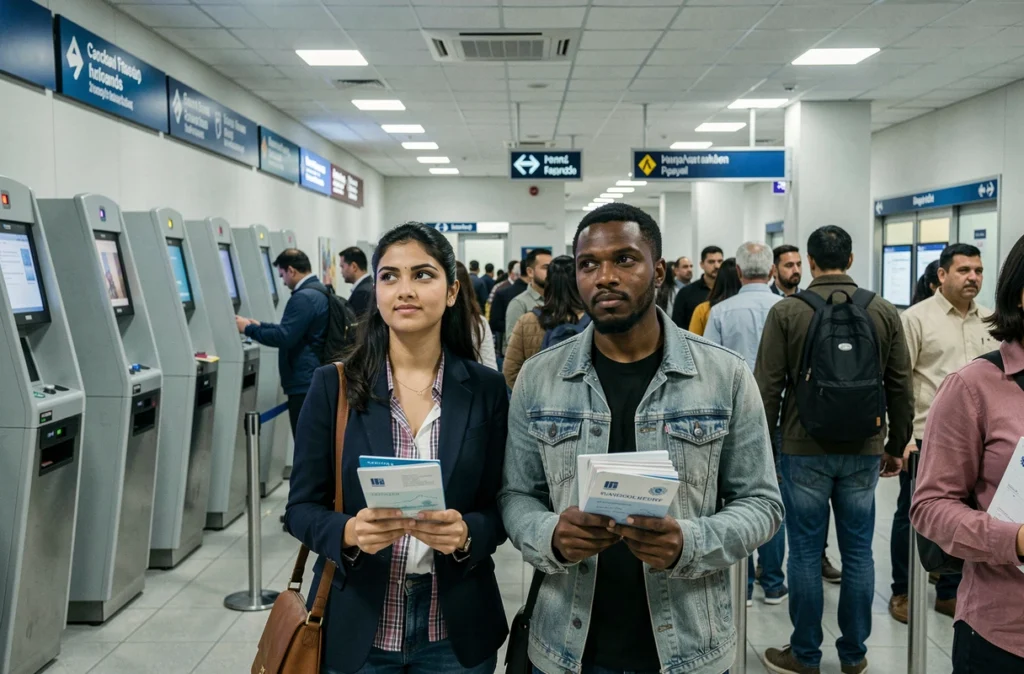
The ETIAS system, which concerns travel authorization for third-country nationals exempt from visas in the Schengen Area, does not directly apply to holders of French TVRs traveling within the Schengen zone with their residence permit. However, for holders of travel documents issued by third countries wishing to enter the Schengen Area, ETIAS verification could add an additional layer of control.
Consular verification before departure: the only reliable method
No online list replaces direct consular verification. Visa policies regarding travel documents for refugees change without notice, sometimes contradicting the information displayed on the government websites of the destination country.
- Contact the consulate of the destination country, specifying that the travel document is a French TVR, not an ordinary passport.
- Request written confirmation (email) of the exemption or visa requirement, to keep during the trip.
- Check transit conditions for each layover, as some countries require a transit visa even for a simple change of plane.
Airlines use the Timatic database to validate documents at the time of check-in. A TVR poorly referenced in Timatic can lead to a boarding refusal even if the destination country allows entry. Reporting the exact type of document when booking reduces this risk.
The maneuvering room for holders of French TVRs remains significantly broader than that of many travel documents for refugees issued by other countries. The European framework and French bilateral agreements open a significant number of destinations, provided that each trip is treated as a complete administrative project, including layovers.