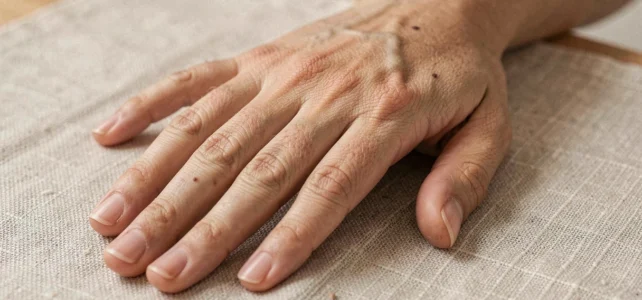
A mole on the middle finger is a melanocytic nevus, a concentration of pigment cells (melanocytes) in the skin. Its location on a finger does not allow for the deduction of a personality trait or fate. The symbolic traditions that associate meaning with each location on the body fall under metoposcopy or Chinese astrology, not medicine. Understanding what this small spot really implies requires distinguishing cultural interpretation from dermatological monitoring.
Metoposcopy and astrology: where the symbolic reading of moles on fingers comes from
Metoposcopy, practiced in Europe since the 17th century, interpreted each skin mark as a planetary imprint received at birth. In this system, the middle finger is traditionally associated with Saturn, a planet linked to discipline, responsibility, and structuring life.
Chinese astrology adopts a different framework. A mole on the right hand is read as a sign of action capability, while on the left, it would refer to inherited predispositions. The middle finger, being the longest, is said to concentrate energy of balance and ambition.
Both traditions attribute qualities of rigor, organizational sense, and sometimes excessive demands to a mole on the middle finger. Some interpretations add a relational dimension: the person would be loyal but selective in their connections. To learn more about Cosmétiques Beauté, these interpretations vary depending on whether the nevus is located on the proximal, middle, or distal phalanx.
None of these readings have measurable scientific foundations. They belong to the realm of beliefs, not diagnosis.
Mole on the middle finger: what dermatology really observes
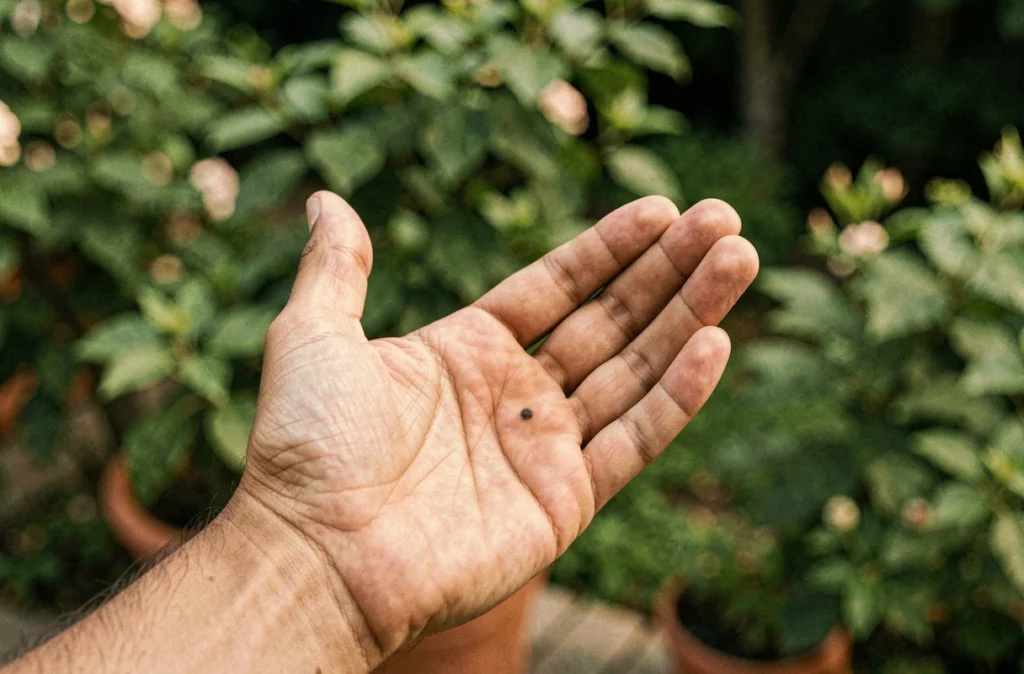
A nevus on a finger is a pigmented lesion like any other, but its acral location (body extremity) deserves particular attention. Acral areas, which include palms, soles, and fingers, are less often inspected during self-monitoring.
The ABCDE rule applied to fingers
The ABCDE method remains the main tool for visual assessment of a mole, regardless of its position on the body. Here are the criteria to observe:
- Asymmetry and Irregular Borders: a nevus whose two halves do not resemble each other or whose outline is jagged requires examination.
- Heterogeneous Color: the presence of multiple shades (brown, black, red, blue) within the same lesion is a warning signal.
- Diameter and Evolution: even a small lesion should be monitored if it changes in shape, thickness, or color over the weeks.
The classic threshold of 6 mm often cited is not sufficient to exclude melanoma. A lesion that evolves, even if small, warrants dermatological advice.
Particular case: pigmentation under the middle fingernail
A brown or black band that appears under the nail and gradually widens, or pigmentation that spreads to the skin around the nail, constitutes a reason for prompt consultation. This type of lesion may correspond to a melanoma of the nail apparatus, a rare form that specifically affects the extremities.
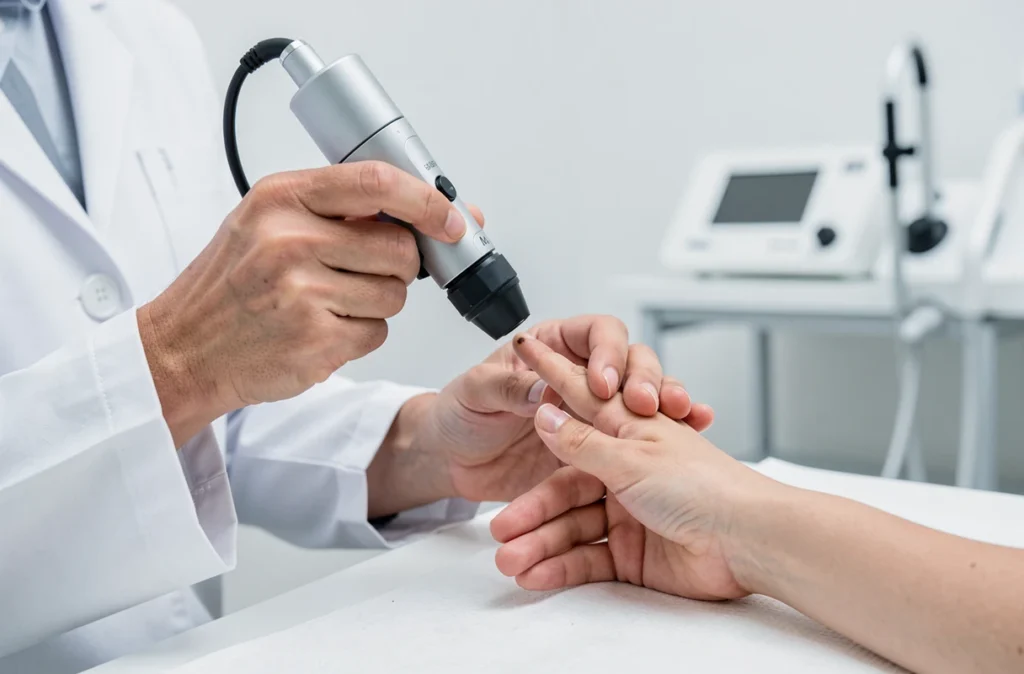
Dermoscopy, a non-invasive examination performed with a dermatoscope, is particularly useful for analyzing a lesion on a finger or under a nail. It reveals pigment structures invisible to the naked eye and allows the doctor to decide if a biopsy is necessary.
Monitoring a nevus on the middle finger: concrete actions to take
A stable mole, present since childhood and appearing homogeneous, generally poses no problem. The difficulty lies in the fact that fingers are exposed to repeated micro-traumas (friction, impacts, cuts) that can alter the appearance of a lesion without it being pathological.
Photographing the nevus every three to six months with consistent lighting allows for objective detection of any changes. A comparative snapshot is better than a vague memory.
Any change in size, shape, color, or sensation should lead to a consultation. This includes spontaneous bleeding, persistent crusting, localized itching, and pain. These signs do not automatically mean melanoma, but they justify a professional examination.
Symbolic meaning or medical vigilance: should we choose?
Reading a symbolic meaning into a mole on the middle finger is not dangerous in itself. The risk arises when cultural interpretation replaces dermatological monitoring, or when it delays a consultation in the face of a changing lesion.
Metoposcopy and Chinese astrology offer frameworks of interpretation that belong to cultural heritage. They speak of personality, relational tendencies, sometimes luck or life challenges. No study has ever correlated the position of a nevus with a psychological trait.
A dermatologist, on the other hand, does not look at the same object. They evaluate cellular structure, pigment regularity, and evolution speed. Both readings coexist without contradicting each other, provided that their fields of application are not confused.
The mole on the middle finger remains a cluster of melanocytes. Its symbolic meaning depends on the consulted tradition. Its medical significance depends exclusively on its evolution over time, and it is this that protects the skin.