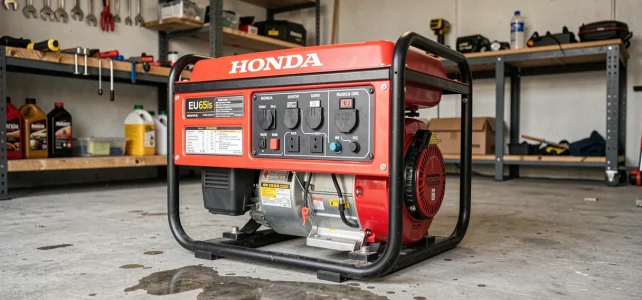
The Honda EX650 is a portable gasoline generator with a design that dates back several decades. Testing this model today is to measure the gap between a generation of generators with basic voltage regulation and the inverter technologies that now dominate the market. This comprehensive test of the Honda EX650 examines its technical features, concrete limitations, and the situations where it remains genuinely relevant.
Honda EX650 vs. inverter generators: a table of technical gaps
The most useful comparison pits the Honda EX650 against current Honda models, notably the EU2200i (also referred to as EU22i in some markets). The table below summarizes the structural differences based on available data.
| Criterion | Honda EX650 | Honda EU2200i/EU22i |
|---|---|---|
| Technology | Classic alternator, nearly fixed engine speed | Inverter (stabilized voltage and frequency) |
| Noise level | Significantly higher than closed models | 57 dB(A) at 7 m |
| Sensitive electronic compatibility | Limited (simple tools, lighting, resistors) | PCs, lithium chargers, measuring instruments |
| Output power | Low (auxiliary use only) | Significantly higher rated power |
| Parts availability | Second-hand market, parts sometimes hard to find | Honda network, new parts available |
The most striking gap concerns the quality of the produced current. A non-inverter generator like the EX650 delivers a voltage whose stability directly depends on the engine speed. Load variations cause fluctuations that modern electronics do not tolerate well.
For those seeking a review of the Honda EX650 before a second-hand purchase, this technological difference is the primary decision criterion.
Voltage regulation and practical uses of the Honda EX650
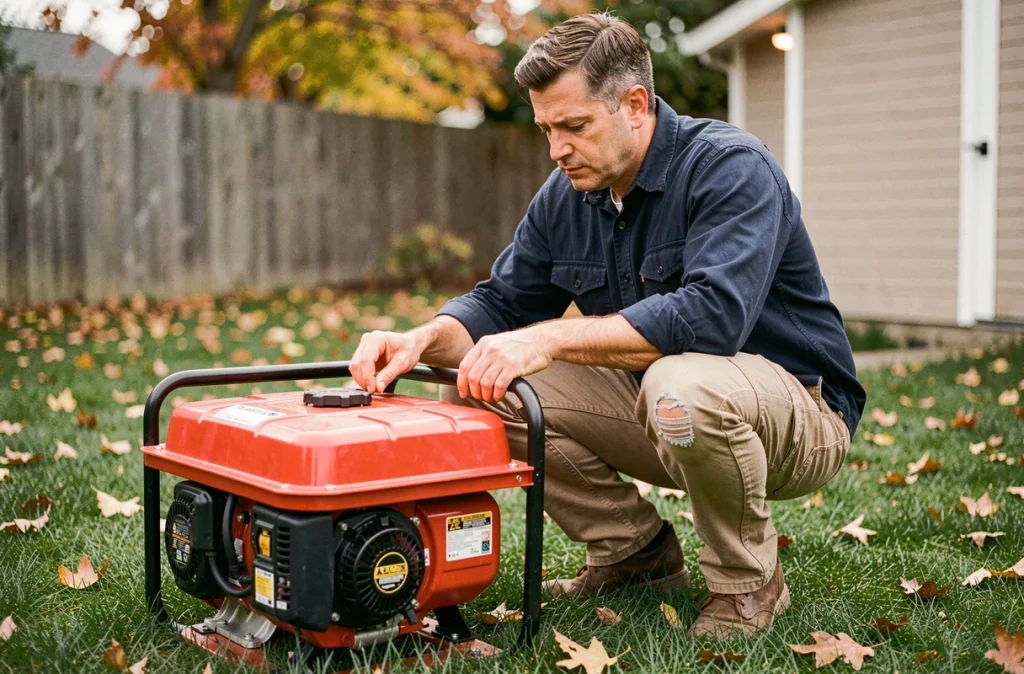
The Honda EX650 uses a basic regulated alternator. The engine runs at a nearly fixed speed, and the output voltage varies according to the connected load. This operation is suitable for less demanding devices: incandescent bulbs, corded drills, small auxiliary heaters.
Connecting a laptop, a lithium battery charger, or a camera to this type of generator poses a real risk. Micro-frequency variations can damage electronic components or cause unexpected shutdowns.
The EX650 remains reliable for lighting and simple motor tools. Its field of use stops there. Any application requiring “clean” current necessitates an inverter generator.
The carburetor issue after prolonged storage
User feedback on specialized forums mentions a recurring problem: after several years of inactivity, the carburetor of the EX650 gets stuck. The throttle and choke disconnect, and internal parts deteriorate. Restarting then requires a complete disassembly of the carburetor and the replacement of components that are sometimes hard to find.
This point distinguishes the EX650 from modern generators equipped with fuel cut-off systems or simplified injection circuits that tolerate long periods of inactivity better.
Noise level: a disqualifying criterion in camping
Noise is probably the most constraining limit of the Honda EX650 in mobile use. Campsites and parking areas now impose contractual noise thresholds that open generators of this generation do not meet.
Recent inverter models like the Honda EU2200i have a noise level of 57 dB(A) at 7 m, comparable to a normal conversation. The EX650, with its open housing and fixed-speed engine, is well above this threshold. In some campsites, its use is simply refused.
- In camping or RV parks, the noise of the EX650 exceeds the generally tolerated thresholds and may lead to refusal of use by the site manager
- In workshops or outdoor construction sites, the noise level remains acceptable since the environment is already noisy
- In domestic emergency use (occasional power outage), the noise can be managed by placing the generator away from the home, but neighbors may pose a problem in dense residential areas
Silence has become the number one criterion in portable generator buying guides. This single factor makes the EX650 unsuitable for the majority of current mobile uses.
Spare parts and mechanical reliability of the Honda EX650 generator
The reputation for reliability of Honda engines is well-established, and the EX650 benefits from it. The engine block, when properly maintained, can run for decades. The basic mechanics (piston, connecting rod, crankshaft) generally pose no problems.
The difficulty lies in wear parts and peripheral components. The carburetor, gaskets, tank, electrical connectors: these elements age, and their replacement requires finding compatible parts on the second-hand market or from specialized dealers. Some parts specific to the EX650 are no longer manufactured, complicating any ambitious restoration.
A portable generator to consider as a backup tool
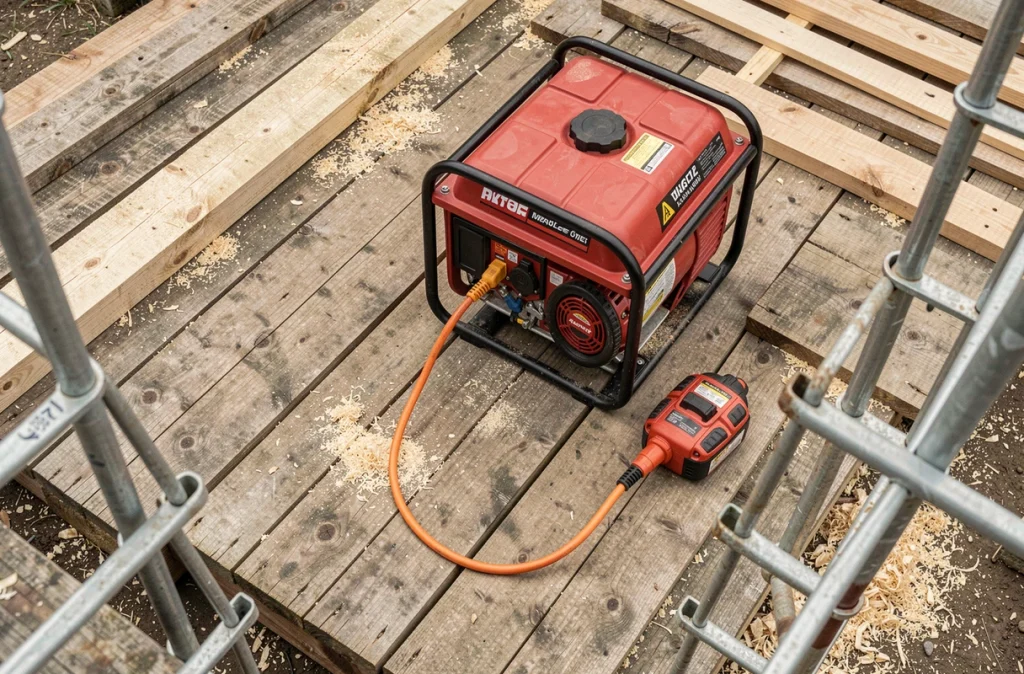
The EX650 retains interest for very targeted use: powering job site lighting, running a drill or grinder during occasional outdoor work. Its compactness and the robustness of its Honda engine make it a decent backup tool, provided it is not asked to deliver what it was never designed to provide.
Acquiring a second-hand EX650 for a few dozen euros can be justified if one accepts its limitations. However, investing time and money in its restoration for regular or versatile use makes no economic sense compared to current inverter generators, whose entry prices have significantly dropped.
The Honda EX650 remains a testament to Honda’s mechanical sturdiness, but inverter technology has rendered its voltage regulation obsolete for almost all contemporary uses. Keeping it as a backup generator in a workshop is defensible. Choosing it as the primary portable solution for camping or domestic backup, however, is not.