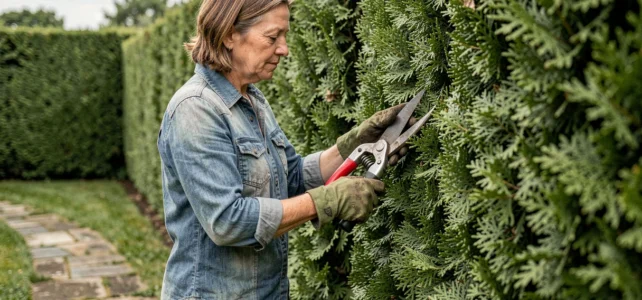
The thuja does not regrow on old wood. This physiological constraint influences every pruning decision and distinguishes a dense hedge from a ragged curtain that is impossible to restore. Properly pruning thujas requires understanding where the boundary lies between the active green wood and the brown lignified area, and then never crossing that line.
Diagnosis of living wood before any thuja pruning
Before taking out the hedge trimmer, we recommend manually moving aside the outer branches to observe the inside of the hedge. The thuja has a green peripheral zone that is photosynthetically active, and a brown core devoid of dormant buds. Any cut reaching the brown area creates a permanent hole.
An abnormal browning is not always due to improper pruning. Repeated water stress during dry summers causes gradual decline. The buprestid beetle and root pathogens like Phytophthora cinnamomi can also be involved. Severely pruning an already weakened thuja worsens the situation.
The correct method is to lightly scratch the bark of a suspicious branch with your nail. If the cambium appears green, the wood is alive and regrowth is possible in that area. If the subcortical tissue is dry and brown, the branch is dead: it should be removed with no hope of regeneration, knowing that the gap will not be filled.
To learn how to easily prune thujas while respecting these biological limits, one must accept that the maximum cutting depth is always a few centimeters back from the brown area.
Trapezoidal profile and cutting angle for a dense thuja hedge
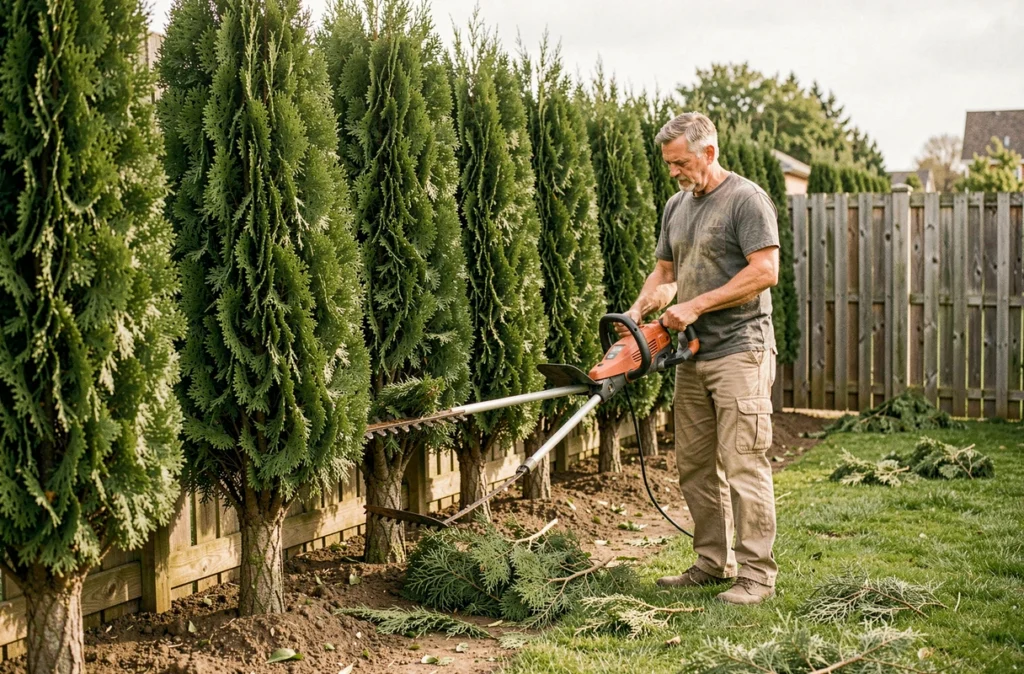
The majority of thuja hedges that are bare at the base suffer from a geometry defect, not a lack of maintenance. A strictly vertical profile deprives the lower branches of light. The more vigorous foliage at the top creates permanent shading that gradually kills the base.
The hedge should be wider at the base than at the top. This slightly pyramidal profile ensures uniform sunlight exposure across the entire height and maintains foliage density down to the ground.
String line method for a consistent result
Planting two stakes at the ends of the hedge and stretching a string line at the desired cutting height remains the most reliable technique. The string line serves as a visual guide for the top. For the sides, we place an inclined batten against the hedge to define the angle of the slope before using the hedge trimmer.
Pruning from bottom to top allows the fallen branches to slide naturally without getting stuck in the lower foliage. The movement should be wide and steady, with the blade slightly tilted inward to respect the trapezoidal profile.
Thuja pruning schedule and regulatory constraints
The thuja grows actively from spring until the end of summer. Two pruning windows are necessary: a first pass in June, a second in September, once the summer growth has finished. The June pruning channels the spring growth. The September pruning refines the profile before winter and gives a neat appearance for several months.
Before each intervention, a visual inspection of the hedge is essential. Destroying a nest, eggs, or chicks of a protected species constitutes an offense. The LPO and OFB recommend avoiding significant pruning from mid-March to the end of August and inspecting the hedge before intervening.
The so-called “March 16 to August 15” rule primarily concerns farmers under the BCAE 8 (CAP conditionality). This period is not a national prohibition applicable to private gardens, but the presence of nesting birds remains a reason for offense independent of the date. In practice, we systematically postpone the main pruning to September for hedges located in peri-urban areas where bird pressure is high.
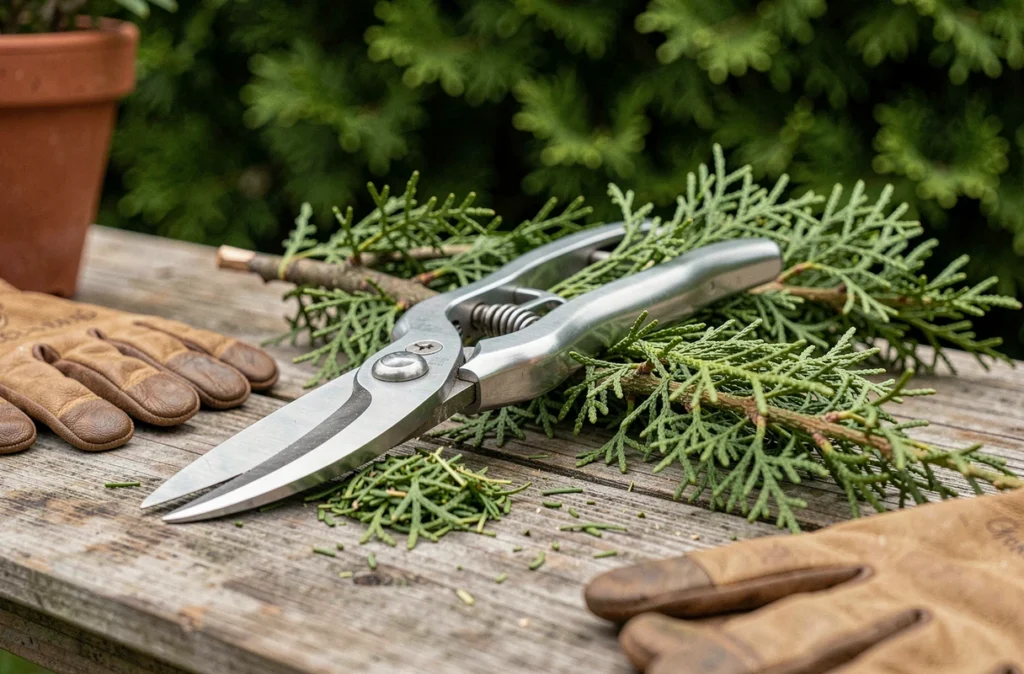
Blade selection and equipment maintenance for pruning a thuja hedge
The resin from thuja clogs the blades much faster than that from privets or laurels. A sticky blade no longer cuts; it tears. Torn fibers brown within days and give a neglected appearance to the hedge.
- Regularly clean the blade during cutting with a cloth soaked in denatured alcohol or a dedicated resin cleaning product. Thuja resin hardens quickly and becomes very difficult to remove once dry.
- Sharpen or have the blades sharpened at least once per season. A well-sharpened hedge trimmer cuts cleanly through the branch, which speeds up healing and limits browning of the tips.
- Disinfect the blades between different hedges if one of them shows signs of Phytophthora or fungal disease. 70-degree alcohol or diluted bleach is sufficient.
A clean and well-sharpened blade speeds up the healing of the cut branches. This is the most underestimated factor in the regular maintenance of thuja hedges.
Blade length suitable for height
For a hedge of moderate height, a medium-length blade offers a good compromise between maneuverability and efficiency. Beyond two meters, a telescopic pole hedge trimmer avoids the use of a ladder, which is a frequent source of uneven cuts and dangerous postures.
Watering and mulching after thuja pruning
Pruning causes mechanical stress. Each cut exposes fresh plant tissue, which temporarily increases evapotranspiration. Generous watering shortly after pruning helps the thuja to restart branch production.
Mulching at the base of the hedge limits summer water stress and maintains consistent moisture in the root zone. Landscapers observe that dry summers cause repeated water stress that promotes irreversible leaf decline. An organic mulch of sufficient thickness, renewed each year, provides effective protection.
- Mulch across the entire width of the hedge, not just at the base of each trunk.
- Avoid using conifer bark that acidifies the soil: prefer hardwood chips or straw.
- Never place the mulch directly against the collar to limit the risk of rot.
A well-maintained thuja hedge remains an effective green screen for several decades. The key lies in three points: never cut into the brown wood, respect the trapezoidal profile at each pass, and compensate for pruning stress with appropriate water management according to soil conditions.