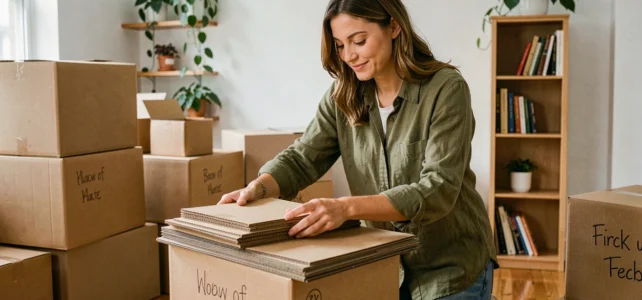
Free eco boxes are not found by chance. Their recovery relies on a collection schedule, a rigorous selection of material, and an understanding of local supply chains. A poorly chosen, damp, or dirty box generates more waste than it prevents.
Weight and Fluting: Technical Criteria for a Reusable Box
A free recovered box is worthless if it breaks at the first handling. The priority data to check is the single or double fluting: double fluting (two corrugated layers between three flat walls) withstands heavy loads like dishes or books. Single fluting is suitable for lightweight items, textiles, or household linen.
The weight of the kraft paper that makes up the outer walls determines rigidity. A box whose wall deforms under thumb pressure has already undergone structural sagging, often caused by residual moisture. We recommend avoiding any box showing signs of condensation, even if dry, as cellulose fibers lose their load-bearing capacity irreversibly after getting wet.
Boxes from household appliances and computer equipment offer the best rigidity-to-volume ratio. Those from fruits and vegetables, despite their massive availability in supermarkets, have two flaws: side openings that weaken the structure and organic residues that attract insects during storage. To find truly usable free eco boxes, it is essential to target stores that receive dry and bulky products.
REP System for Professional Packaging: A Window Closing in 2027
The decree no. 2025-1081 of November 17, 2025 creates an extended producer responsibility (REP) system for professional packaging, applicable from January 1, 2027. This text will structure the collection, reuse, and recycling of boxes used by businesses and shops.
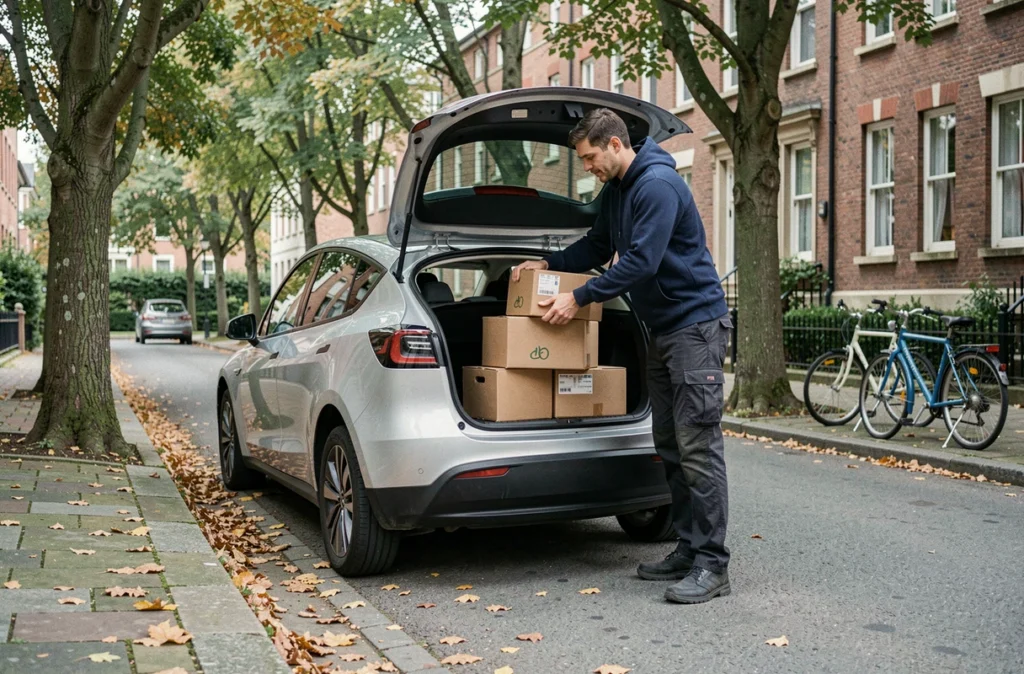
In practical terms, merchants who currently leave their empty boxes available for free in front of their store or next to the bin will be encouraged to direct them to an approved eco-organization. The informal recovery of boxes from professionals, the main source of free packaging for a move, is likely to diminish once the system is operational.
We observe that the current period, before the effective implementation, remains favorable for direct recovery. It is enough to ask the merchant for permission and respect their delivery slots, usually early in the morning or late in the day.
Where to Recover Boxes Before the System is Established
- Large supermarkets often provide empty boxes at the checkout or unpacking area, available upon request from the department manager
- Electronics and appliance stores generate large-format boxes with double fluting, perfect for bulky or fragile items
- Pharmacies and drugstores receive small-format boxes, clean and dry, suitable for bathroom items and valuable products
- Local reuse associations (resource centers, recycling centers) collect and redistribute sorted boxes, sometimes for free
Reuse of Packaging in France: A Still Marginal Rate
In France, only 1.82% of packaging placed on the market was reused in 2024, according to the National Observatory for Reuse and Reutilization led by ADEME. The trajectory set by the AGEC law aims for 10% by 2027. The gap between these two figures shows that packaging designed for multiple rotations remains rare on the market.
For an ecological move, this means that boxes labeled “reusable” sold commercially are not yet standardized. Most so-called “eco-friendly” boxes are simply made from recycled paper, which has nothing to do with the ability to withstand multiple cycles of use.
A recovered box reused two or three times pollutes less than a new recycled paper box used only once. The issue is not the manufacturing material but the actual number of rotations before disposal.
Alternatives to Boxes for a Zero Waste Move
Reducing the volume of boxes needed involves replacing some packaging with containers already present in the home. Suitcases, sports bags, laundry baskets, and rigid storage bins can easily absorb a quarter of the total volume to be transported.
Newspaper, often recommended for padding, leaves ink marks on light-colored items. We recommend using unprinted kraft paper or towels and sheets as interleaving protection. Textiles serve a dual purpose: they protect and are themselves transported.
- Reusable plastic bins, offered for rent by some moving companies, withstand dozens of rotations and can be stacked without adhesive tape
- Duvet covers and pillowcases filled with soft items (clothes, stuffed animals, cushions) form compact and lightweight bundles
- Rigid plastic food storage containers effectively protect small dishes and glasses
Closure and Padding Without Plastic Tape
Polypropylene adhesive tape represents a waste that is difficult to recycle. The gummed kraft tape, activated with water, adheres to the box and can be recycled with it in the paper-cardboard stream. Its cost per meter is comparable to that of standard plastic tape.
For internal padding, crumpled paper effectively replaces bubble wrap. A single crumpling pass is enough to create a protective air volume around fragile items. Bubble wrap, on the other hand, is only accepted in the flexible plastic stream, which is rarely collected door-to-door.
An ecological move does not rely on a miracle product labeled green, but on reducing the number of new packages purchased and discarded after a single use. Every recovered and reused box prevents the production of a new box, regardless of the material of the latter.