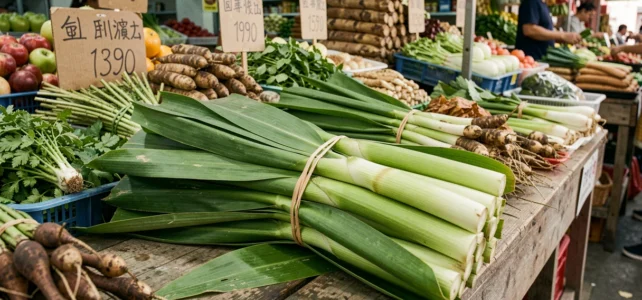
When preparing a chiffon cake or a coconut-pandan latte, you open the cupboard, and the question arises: where to find these long, fragrant leaves in France, a country where the plant does not grow naturally? Pandan remains a niche ingredient in the Hexagon, distributed irregularly, and availability varies by city and season.
EU Phytosanitary Regulations and Importing Fresh Pandan
Before discussing addresses, it’s helpful to understand why fresh leaves are so difficult to find. The issue is not just logistical; it is also regulatory.
Since August 14, 2026, the Delegated Regulation (EU) 2026/1195 complements Regulation (EU) 2016/2031 and formalizes a procedure to classify certain plants and plant products as “high phytosanitary risk.” When a plant is listed, its imports are provisionally banned from the start of the assessment, not at the end.
Pandan is not explicitly mentioned in the lists published to date. However, any uncommon tropical plant can be classified, which poses a real risk for importers.
Specifically, a wholesaler importing fresh leaves from Vietnam or Thailand must check whether their product falls under the CHED-D (control of foodstuffs of non-animal origin) or CHED-PP (phytosanitary control of plants) systems. The boundary between the two regimes is not always clear for a product as specific as pandan leaves.
This regulatory ambiguity partly explains why the arrivals of fresh leaves remain unpredictable in the French market. We look for pandan leaves like we look for fresh galangal: when they are available, we take them, and we plan ahead for the next time.
Asian Grocery Stores and Online Ordering: Concrete Channels
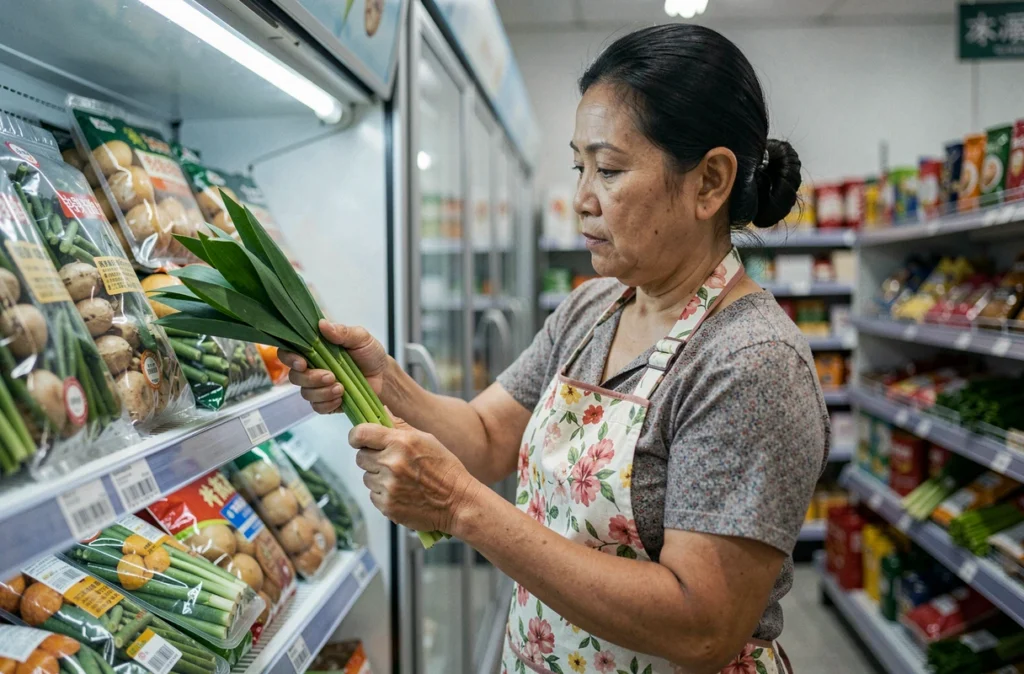
In practice, pandan leaves (fresh, frozen, or dried) can be found through two main channels in France. We can delve deeper into the question of where to find pandan leaves based on your location and needs.
Specialized Physical Grocery Stores
Stores like Tang Frères or Paris Store, concentrated in Île-de-France and a few major cities, are the first reflex. They regularly import fresh products from Southeast Asia, but the presence of pandan leaves in the fresh section entirely depends on the week’s arrivals.
Calling ahead avoids an unnecessary trip. Asking specifically for “lá dứa” (Vietnamese name) or “bai toey” (Thai name) sometimes helps when the staff is unfamiliar with the French term. Smaller neighborhood Vietnamese and Thai grocery stores may also have them occasionally, often in the frozen section rather than fresh.
Online Ordering with Refrigerated Delivery
Several online Asian grocery sites offer pandan leaves, usually in 200 g packets. Asiamarché, for example, lists fresh leaves shipped via Chronopost within 24 hours. Cash Alimentaire du Sud-Est operates on a pre-order system, meaning the product is ordered from the supplier upon receiving the customer request.
- Check that the site offers refrigerated parcel delivery, as fresh leaves quickly turn black at room temperature
- Prefer sites that clearly indicate the origin (Vietnam, Thailand) and the net weight of the packet
- Compare shipping costs: on a product costing a few euros, express delivery can be several times the price of the packet
Pandan Powder, Extract, or Frozen: Choosing the Right Form
When fresh leaves are unavailable, you don’t have to be stuck. Pandan exists in several forms, each suited for specific culinary uses.
Natural Pandan Powder
This is the easiest form to store and order. It can be found on Amazon, in certain specialty grocery stores, and on websites dedicated to Asian ingredients. A 200 g packet is sufficient for several recipes for cakes or drinks.
Checking the ingredient list is necessary: some powders contain artificial colorings (bright green E142 or similar) that have nothing to do with natural pandan. A powder that is 100% dried and ground pandan leaves has a dull khaki green color, not fluorescent green.
Frozen Leaves
Freezing preserves the aroma of the leaves quite well. They can be used directly by immersing them in hot liquid (coconut milk, syrup, rice cooking water) without prior thawing. The fragrance is less intense than with fresh, but significantly better than a synthetic extract.
Liquid Pandan Extract
Available in small bottles at most Asian grocery stores, the extract is convenient for quick drinks and desserts. Again, two categories coexist:
- Natural extracts, obtained through maceration or distillation, with a subtle green color
- Artificial extracts, very colorful, whose taste vaguely resembles vanilla but lacks the complexity of true pandan
- In case of doubt, a natural extract will display “Pandanus amaryllifolius” in its composition, not just “flavor”
Storing Pandan Leaves After Purchase
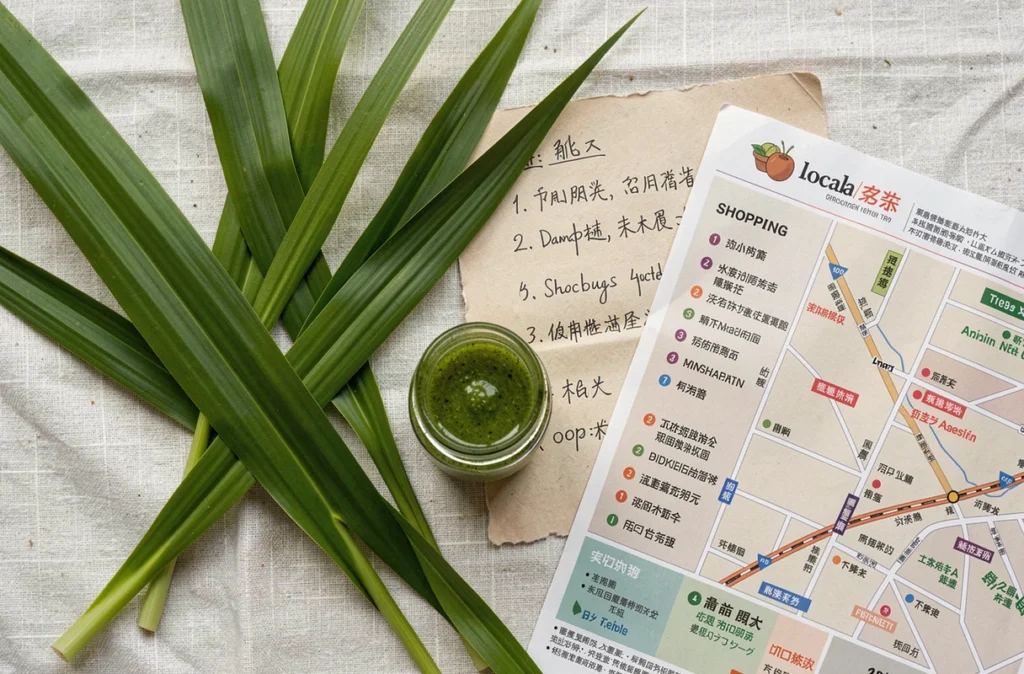
Once you have found your leaves, the next step is to avoid wasting them. Fresh leaves can be stored for a few days in the refrigerator, wrapped in a damp paper towel and placed in a perforated plastic bag. Freezing remains the best option for long-term storage: cut the leaves into sections, lay them flat in a freezer bag, and they will retain their aroma for several months.
For the powder, a resealable packet stored away from light and moisture will maintain its aromatic properties for a long time. Once opened, the liquid extract should be kept in the refrigerator.
Pandan remains an ingredient that requires a bit of foresight in France. Supply channels exist, but they work best when you know exactly which form to look for and are willing to order in advance rather than hoping to find a shipment in-store.