
Your baby pushes away the pacifier, cries after a few sips, or seems to swallow a lot of air. Before making multiple purchases, choosing the right bottle deserves real consideration. Mam and Avent (Philips) consistently appear in recommendations, but these two brands do not address the same situations. Understanding their concrete differences can save weeks of trial and error.
Anti-colic system: two very different technical approaches
Have you noticed that some bottles produce bubbles in the milk during feeding? These bubbles, swallowed by the infant, are one of the common causes of colic and digestive discomfort. Mam and Avent tackle this issue, but in completely different ways.
The Mam Easy Start Anti-Colic bottle uses a ventilated base. Air enters from the bottom of the bottle and does not mix with the milk. The infant drinks a liquid that is almost free of bubbles or foam. This system works well, but it requires precise assembly: the base must be properly screwed on after each cleaning for the ventilation to remain effective.
At Philips Avent, the Natural Response range adopts a different logic. A valve integrated into the nipple regulates the flow: milk only flows when the baby actively sucks. Between two sucks, the flow stops. This mechanism limits air intake by controlling the flow rather than managing air within the bottle.
In practice, if your baby suffers from significant colic with a lot of burping and gas, the base system (Mam) directly targets the problem of air in the milk. If your priority is to slow down a baby who drinks too quickly and chokes, Avent’s demand flow will be more suitable. To choose a Mam or Avent bottle, this technical distinction is the first criterion to consider.
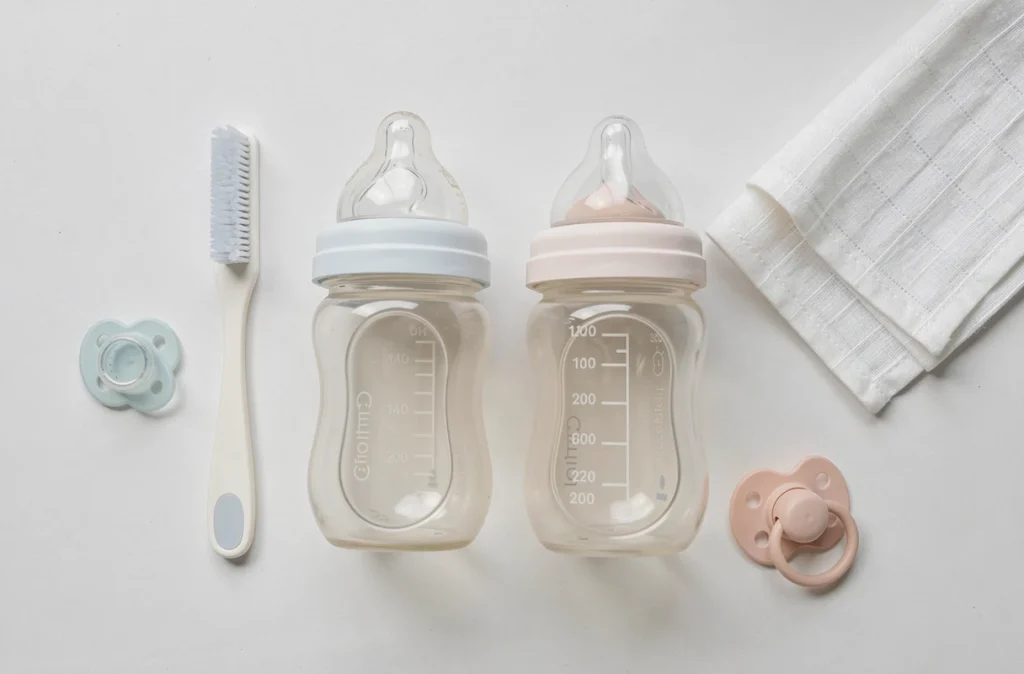
Nipple and breast-to-bottle transition: the detail that changes everything
The nipple matters more than the bottle itself. An infant may refuse a bottle not because of the milk or temperature, but because the shape of the nipple does not suit them.
Mam offers a flat, anatomical silicone nipple called “SkinSoft” (a brand-specific term). Its very soft texture and flattened shape aim to replicate the sensation of the breast in the mouth. For breastfed babies transitioning to a bottle, this flat nipple is often well accepted, as the sucking motion remains close to that of breastfeeding.
Avent Natural Response uses a rounder nipple with a single opening. The “anti-drip” function requires the baby to exert a sucking effort comparable to that of breastfeeding. The natural feeding rhythm is preserved, with spontaneous pauses during bottle feeding.
Why does this choice matter so much? A baby used to breastfeeding who receives a bottle with too fast a flow may develop a preference for the bottle and later refuse the breast. Both brands limit this risk, but in different ways:
- Mam focuses on the shape and texture of the nipple so that the sensation in the mouth remains familiar to the breastfed baby
- Avent focuses on flow control so that the sucking effort remains comparable to that of breastfeeding
- In both cases, starting with a slow flow (newborn nipple) remains the basic recommendation for mixed feeding
Maintenance and assembly in daily life: Mam or Avent at three in the morning
Comparisons often overlook a very concrete aspect: how many pieces need to be assembled at three in the morning, in the dark, with a crying baby?
The Mam bottle consists of more parts than a standard bottle. The ventilated base screws on separately, adding an element to assembly and cleaning. The advantage of this wide base: it facilitates filling and the passage of the cleaning brush. Cleaning each component is straightforward, but the number of pieces to dry and assemble increases preparation time.
The Avent Natural Response bottle has a more straightforward assembly, with fewer separate components. The valve is integrated into the nipple, reducing the number of parts to manage. For parents preparing several bottles a day, this simplicity of assembly saves a few minutes with each feeding.
Both brands are dishwasher and sterilizer safe. The difference really lies in the daily routine, not in compatibility with equipment.

Materials and safety: what product sheets say in 2026
Most parents check that their bottle is “BPA-free.” This criterion has become a regulatory standard in Europe. However, one point often goes unnoticed in usual comparisons: Mam Easy Start Anti-Colic bottles are described as BPA and BPS-free in product sheets updated in 2026. BPS (bisphenol S) is a substitute for BPA whose effects are still under research. This double mention remains rare in the industry.
Another recent development at Mam: some Easy Start Anti-Colic models are made from bio-renewable materials, not just conventional polypropylene. Several European distributors have been highlighting this argument in their product sheets since 2024.
At Philips Avent, bottles are available in glass or plastic (BPA-free polypropylene). Glass remains the most chemically neutral choice, but it is heavier, which matters when the baby starts holding their bottle alone.
Which material for which use
- Glass is suitable for home use, especially in the first months when parents hold the bottle
- Plastic (or bio-renewable materials at Mam) is preferable when on the go and when the child handles the bottle alone
- Having one or two glass bottles for home and lightweight bottles for outside is a common and functional combination
The best bottle is the one your baby accepts. Buy a single small size from each brand before investing in a complete set. A rejected bottle does not mean the brand is bad: sometimes it just takes changing the nipple flow or trying again a few days later.