
The string trimmer is the tool that transforms a decent mowing into a neat finish. Cord, battery, gas: each type of motorization imposes its constraints of weight, noise, and autonomy, and the choice is not just about comparing technical specifications. Since 2023, regulations on neighborhood noise have tightened penalties, adding a criterion rarely considered in traditional buying guides.
Fines and time restrictions: noise as a priority over power
The decree n°2023-924 of October 5, 2023 has raised the fixed fine for neighborhood noise to 135 euros, and up to 750 euros in case of repeat offenses. In severe cases, the confiscation of the noisy tool is possible. This tightening changes the game for anyone hesitating between a gas model and an electric model.
Field reports vary on this point: some municipalities apply these penalties zealously, while others remain tolerant. However, the trend is clear. Since June 2025, about twenty departments in the South and Southwest (Var, Gard, Hérault, Gironde, Charente, Aveyron) have prohibited the use of noisy gardening equipment between 12 PM and 4 PM during heatwave alerts.
A powerful gas string trimmer thus becomes a tool with restricted use in these areas. For a modest-sized garden in an urban or suburban setting, a battery or corded model avoids any regulatory risk. This is not a marketing argument; it is a measurable legal constraint. Comparing available models on taille-bordure-warrior.com allows for quick filtering by type of motorization and announced noise level.

String trimmer motorization: cord, battery, or gas
The debate over motorization structures the entire market. Each technology caters to a specific garden and user profile.
Corded: lightweight and limited
The corded electric string trimmer remains the lightest and least expensive. Its power, suited for soft grass and finishing along a terrace, is ideal for small city gardens. The main constraint is obvious: the cord limits the range of action and requires an extension, with the well-known risk of cutting it mid-job.
Lithium-ion battery: the dominant compromise
The battery model (18V or 36V) has taken a central place in recent years. Autonomy remains the weak point: depending on the battery capacity and vegetation density, a full charge covers a work session ranging from twenty minutes to over an hour.
Interchangeable battery systems between tools of the same brand represent a real economic argument. If you already own a drill or mower from a manufacturer, checking battery compatibility before purchasing a string trimmer avoids redundant investment.
Gas: power for large areas
The gas engine delivers the highest power and does not depend on any outlet or battery autonomy. However, weight, noise, and maintenance (oil change, spark plug, air filter) make it a tool reserved for large areas or tall, tough grasses. With the regulatory tightening mentioned earlier, its use in densely populated residential areas is becoming increasingly constrained.
Cutting width and type of line: what changes the finish
While motorization attracts attention, the quality of the cut mainly depends on the cutting width and the diameter of the line. A thin line is suitable for soft grasses and produces a clean cut. A thicker line withstands dense grasses and weeds but leaves a coarser finish.
- Round line: versatile, suitable for most regularly maintained gardens. Clean cut on soft grass.
- Square or star-shaped line: designed for thick grasses and established weeds. Cuts woody stems better but wears out faster on hard ground.
- Helical or twisted line: reduces cutting noise and limits vibrations, an advantage for long sessions or in noise-sensitive areas.
The cutting width, generally between 23 and 38 cm on standard models, determines the work speed. A device with a wide cutting path covers more area per pass but weighs more and consumes more energy. For narrow flowerbed or pathway borders, a reduced width offers more precision.
Ergonomics and weight of the string trimmer: beyond the technical sheet
A string trimmer is held at arm’s length, often tilted, during sessions that can last. The actual weight in use (with a charged battery or full tank) can differ significantly from the weight stated on the packaging. Corded models remain the lightest. Gas models often exceed four kilograms, which can tire the arms and shoulders in a medium-sized garden.
Two ergonomic elements deserve particular attention:
- The adjustable auxiliary handle: it allows for adapting the grip to the user’s size and working vertically (curb edges) as well as horizontally (top of walls).
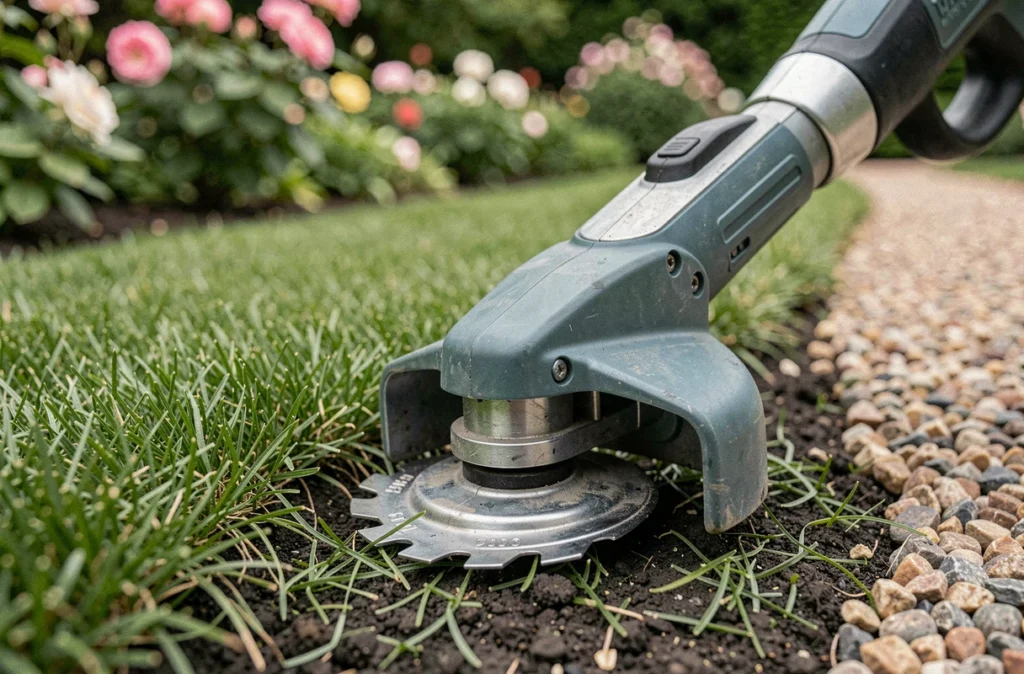
- The adjustable or pivoting head: it transforms the string trimmer into a mini brush cutter for hard-to-reach areas without straining the back.
- The harness or shoulder strap: on heavier models, it distributes the weight across the torso and significantly extends working comfort.
The available data does not allow for concluding that one brand systematically dominates in ergonomics. Differences are model-specific, and trying the device in-store remains the most reliable test before making a purchase.
Maintenance of the string trimmer: what conditions its lifespan
An electric string trimmer (corded or battery) requires almost no mechanical maintenance. Cleaning the casing after each use and replacing the line as needed is sufficient. The lithium-ion battery gradually loses capacity over charge cycles, but recent models can withstand several hundred cycles before noticeable degradation.
The gas model requires regular maintenance: engine oil changes, spark plug replacement, air filter cleaning. Neglecting these steps shortens lifespan and degrades performance. For a homeowner using their device a few hours a month, this maintenance represents a disproportionate constraint compared to the power gain.
The cost of use over several seasons (cutting line, replacement batteries, engine parts) can sometimes weigh as much as the initial purchase price. Integrating this parameter from the start avoids unpleasant surprises and often steers the choice towards a battery model for a standard-sized garden.